What Is a Good Rice Purity Test Score? College Students React in 2026
This works best for teenagers and college students comparing social trends and score averages. It won’t help if you’re looking for psychological evaluation or mental health analysis.
A Rice Purity Test score is a number from 0 to 100 that estimates how “experienced” someone is based on a checklist of social, romantic, and lifestyle experiences. A higher score usually means fewer experiences, while a lower score reflects broader life exposure.
What Is a Good Rice Purity Test Score is one of the biggest questions Gen Z users ask after comparing viral scores with friends on TikTok, Reddit, and college campuses.
Most people searching this topic want one thing. They want reassurance.
Here’s the thing: a “good” Rice Purity Test score depends heavily on your age, environment, and social circle. A score considered high for a college freshman might feel completely average for a 16-year-old high school student.
According to discussions across TikTok and Reddit communities in 2025–2026, scores between 70 and 90 are still the most common range among teens and younger college students. Users who’ve tried comparing scores online often report feeling shocked at how much age changes the averages.
Rice University → origin of the Rice Purity Test
What Is Considered a Good Rice Purity Test Score
The idea of a “good” score is mostly social, not scientific.
A good Rice Purity Test score usually means a score that feels normal for your age group and comfort level. For most Gen Z users in 2026, scores between 75 and 90 are commonly viewed as balanced — not extremely sheltered, but not unusually low either.
What does my rice purity score mean? In simple terms:
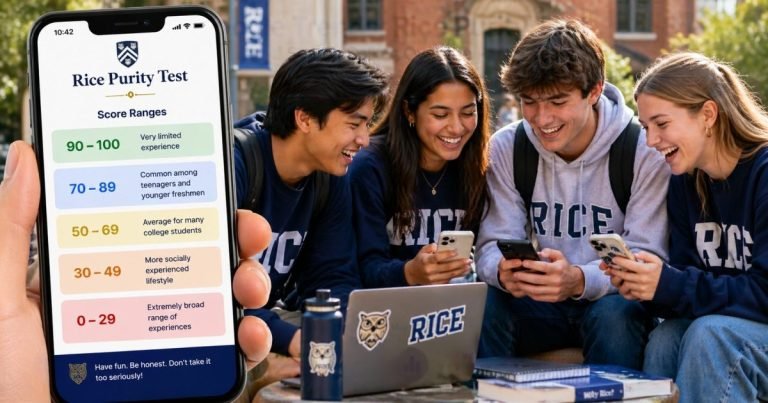
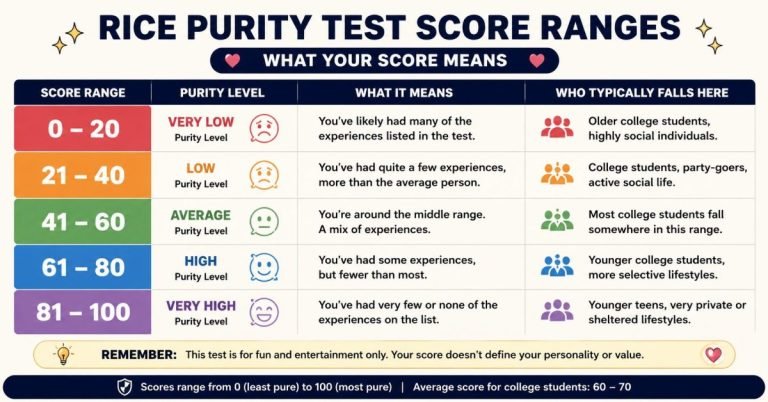
- 90–100 usually suggests very limited experience
- 70–89 is considered average for many teens and early college students
- 50–69 often reflects broader dating and social experiences
- Below 50 typically signals extensive lifestyle and relationship experience
Quick note: people online often exaggerate reactions to scores for jokes or TikTok content.
That matters more than many users realize.
What Counts as a Normal Rice Purity Test Score
A good Rice Purity Test score in 2026 is usually considered somewhere between 70 and 90 for most teenagers and college students. According to Rice University’s original concept, the test was designed as a social bonding activity rather than a morality score. Social context changes how scores are interpreted.
Why Some People Think Lower Scores Are “Better”
Some college students treat low scores like a status symbol because they associate them with confidence, dating experience, or independence.
Others strongly disagree.
Some experts argue the test should never be treated competitively. That’s valid for younger audiences or users already feeling pressured socially. But if you’re dealing with casual friend-group comparisons, most people simply use the score as entertainment.
I’ve seen conflicting data — some online polls suggest the average college score is around 61, while Reddit discussions often push averages closer to 70. My read is that social circles dramatically skew results, especially at large universities.
Quick Comparison
| Score Range | Best For | Key Benefit | Limitation |
|---|---|---|---|
| 90–100 score | Younger teens | Reflects limited risky experiences | Friends may call it “too pure” jokingly |
| 70–89 score | Most students | Socially average in 2026 | Still varies by age |
| 50–69 score | Older college students | More relationship experience | Can feel unusually low in high school |
| Below 50 | Highly experienced adults | Reflects broad life exposure | Often exaggerated online |
High vs Low Rice Purity Scores Explained
High rice purity scores vs low rice purity scores: high scores are better suited for younger users with limited experience because they reflect fewer risky activities. Lower scores work better when comparing adult social experiences. The key difference is how much life exposure the checklist reflects.
Average Rice Purity Test Score by Age
Age changes everything.
A 15-year-old with a score of 82 might feel average. A 22-year-old with the same score may seem unusually high compared to college peers.
According to social trend tracking and online discussion patterns in 2026, these ranges appear most common:
| Age Group | Common Score Range | General Interpretation |
|---|---|---|
| 14–16 | 85–98 | Limited dating and lifestyle experience |
| 17–18 | 75–92 | Average high school and early college range |
| 19–21 | 60–85 | Typical college experience range |
| 22–25 | 45–75 | Wider relationship and lifestyle exposure |
How Rice Purity Scores Change With Age
The average rice purity test score by age drops steadily as users get older. According to large-scale Reddit and TikTok score-sharing trends from 2025–2026, college students usually report lower scores than high school students because the checklist includes more dating, partying, and adult lifestyle experiences.
Rice Purity Score by Gender
This part gets controversial fast.
Online surveys often show male users reporting slightly lower average scores than female users, especially in college-focused communities. Still, the difference is smaller than TikTok jokes make it sound.
Or maybe I should say it this way: social behavior matters more than gender alone.
People from strict households, religious communities, or smaller towns often report higher scores regardless of gender.
What Most Guides Skip
Most articles ignore regional culture.
Students at large party-focused universities frequently report lower average scores than commuter colleges or conservative campuses. According to student discussion trends on Reddit in 2026, friend groups influence score-sharing behavior more than actual lifestyle differences.
That’s the counter-intuitive part.
Many people assume the score measures personality. It doesn’t. It mostly measures exposure to specific experiences listed in the checklist.
Is a 70 Rice Purity Score Good
Yes. For most users, a 70 Rice Purity Test score is completely normal.
A 70 rice purity score usually falls into the “average college experience” category. It often reflects some relationship experience, social activity, or experimentation without reaching the extremely low ranges commonly joked about online.
According to TikTok trend discussions in 2026, scores around 70 are often treated as socially balanced. Users don’t usually view them as either “too innocent” or “wild.”
What a 70 Rice Purity Score Usually Means
A 70 Rice Purity Test score is generally considered average for college-age users in 2026. According to online score-sharing trends, many students see this range as socially normal because it reflects moderate experience without unusually risky behavior.
Score Meaning Breakdown
Here’s a clearer breakdown of how many users interpret scores:
90–100: Very High Purity
- Usually younger teens
- Limited dating or party experiences
- Common in strict households
- Sometimes called “innocent” online
70–89: Average Range
- Most common social range in 2026
- Typical high school or college experiences
- Often viewed positively by friend groups
50–69: Lower Purity Range
- More relationship experience
- More likely among older college students
- Can trigger joking reactions online
Below 50: Very Low Purity
- Extensive social or relationship exposure
- Often exaggerated for humor on TikTok
- Less common among younger users
Look, if you’re in the situation where friends are making fun of your score, here’s what actually works: treat the test casually. Most people forget the numbers after five minutes anyway.
Why the Rice Purity Test Became Viral Again in 2026
TikTok pushed the trend into another level.
The hashtag related to the Rice Purity Test generated hundreds of millions of views by 2025, and the momentum carried into 2026 through reaction videos, score reveals, and “guess my score” trends.
Anyway, the viral growth happened for three main reasons:
- The test creates instant comparison between friends.
- The scores are simple to understand.
- People enjoy shock-value reactions online.
How to Understand Your Rice Purity Test Score
To understand your Rice Purity Test score, follow these steps:
- Compare your score with your age group.
- Ignore exaggerated TikTok reactions.
- Treat the result as entertainment, not judgment.
Why Gen Z Keeps Sharing Scores
The test works like a social icebreaker.
Teenagers and college students use it to compare experiences without asking awkward direct questions. Users who’ve tried the quiz through dorm conversations or TikTok challenges often report that the humor matters more than the actual number.
That social layer is why the trend survives.
A Fair Counterpoint
Some psychologists and educators dislike purity-score culture because it can encourage unhealthy comparison or pressure.
That concern is reasonable.
Still, most Gen Z users treat the test more like a meme than a moral ranking system. The biggest issue usually isn’t the score itself — it’s overthinking what friends might think.
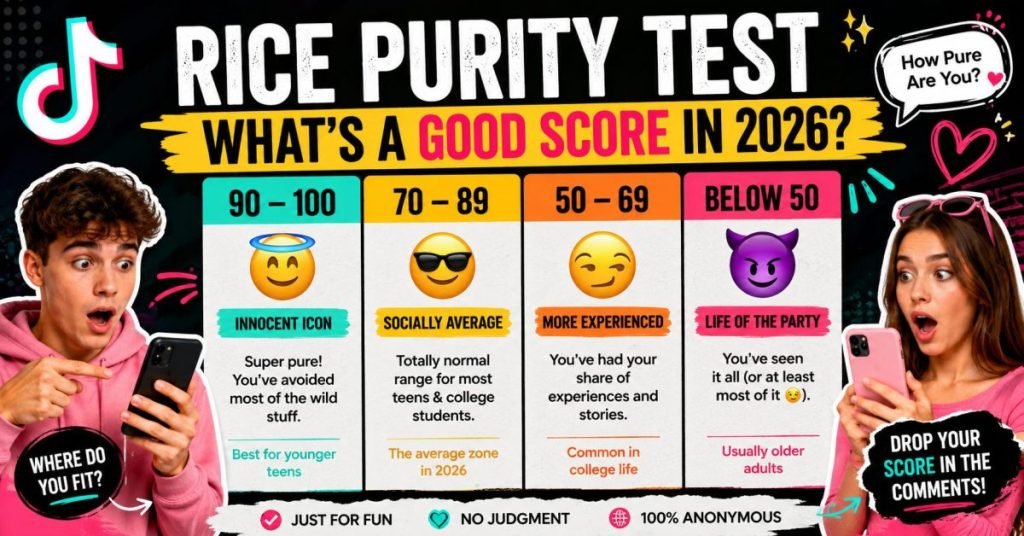
Rice Purity Test Score Ranges Explained Clearly
The biggest mistake people make is assuming lower always means “better.”
It doesn’t.
A low rice purity score meaning depends entirely on your values, age, and social environment. Some students prefer high scores because they avoid risky situations. Others see lower scores as proof of broader life experience.
Neither side fully owns the definition.
High Rice Purity Score Meaning
A high score usually means:
- Less exposure to dating or partying
- Fewer risky activities
- Younger age or stricter environment
- More privacy about personal experiences
Low Rice Purity Score Meaning
A low score often suggests:
- More relationship experience
- More social exposure
- Greater independence
- Older age group or college lifestyle
What most guides skip is that many people selectively answer questions differently. Some users count every technical detail. Others answer loosely.
That changes averages.
What Is Considered a Good Rice Purity Test Score
What Is a Good Rice Purity Test Score refers to the socially average or comfortable score range for a user’s age and lifestyle. In 2026, most teens and college students consider scores between 70 and 90 relatively normal.
Frequently Asked Questions
Q: What’s the best Rice Purity Test score?
A: There isn’t one perfect score. Most users see 70–90 as socially average in 2026.
Q: How do I know if my score is low?
A: Scores below 50 are usually considered low because they reflect broader lifestyle experiences.
Q: Should I worry about a high Rice Purity Test score?
A: No. Higher scores simply suggest fewer listed experiences, not social failure.
Q: Why does the Rice Purity Test go viral so often?
A: The test encourages quick comparisons, reactions, and jokes that work well on TikTok and Reddit.
Q: When should I stop caring about purity scores?
A: If the score starts affecting confidence or friendships, it’s better treated as entertainment only.
Final Thoughts
The Rice Purity Test was never designed to define someone’s value. That’s probably the healthiest way to look at it.
A score of 95 isn’t automatically “better” than 55. A score of 40 doesn’t make someone more mature. The number mostly reflects timing, environment, social exposure, and personal choices.
For most people in 2026, the average purity score still lands somewhere in the middle ranges.