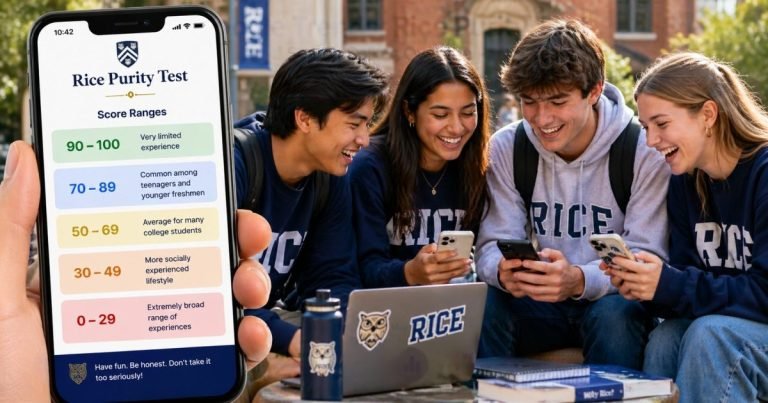
Rice Purity Test Score Meaning by Age, Score Range, and Trends
Rice purity test score meaning refers to how many life experiences a person has not had according to the Rice Purity Test checklist. The test starts at 100 points. Every checked experience lowers the score.
A higher score usually suggests fewer romantic, social, or risky experiences. A lower score usually reflects broader life exposure.
That’s the basic idea. But online? People treat the score like a personality label.
That’s why so many users search things like:
- “What does rice purity score mean?”
- “Is 70 a good rice purity score?”
- “What is a normal rice purity score?”
Most people aren’t looking for math.
They want reassurance.
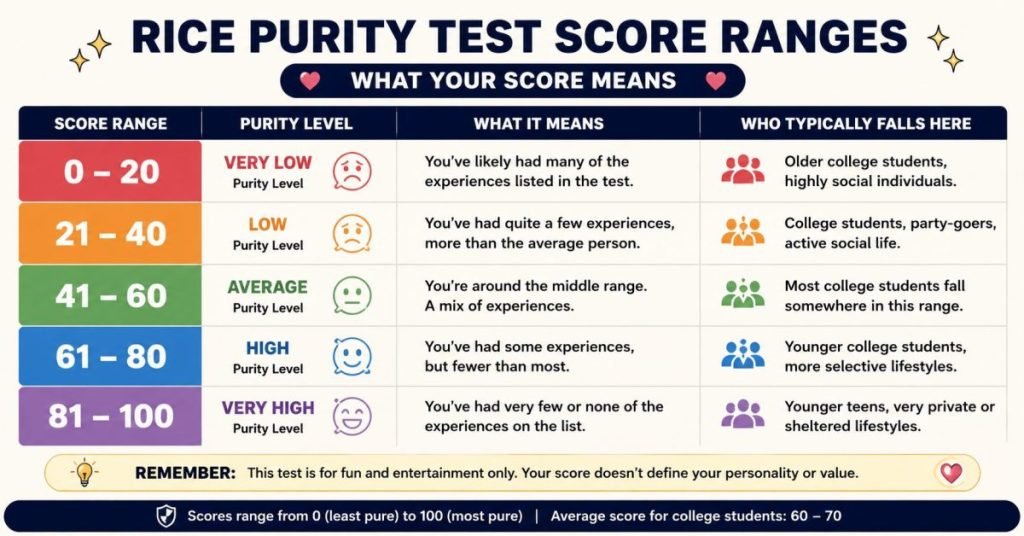
According to Google Trends data from 2024, searches for “Rice Purity Test” spike heavily during college admission periods and freshman orientation seasons. The quiz spreads fast because people compare scores with friends on TikTok, Reddit, and Instagram.
Rice Purity Score Meaning by Number
- Different score ranges create different reactions online.
- Some of those reactions are accurate.
- A lot aren’t.
90–100 Score Meaning
A score between 90 and 100 is considered very high.
- This usually means the person has had limited dating, party, or relationship experiences.
- For teenagers, this range is extremely common.
- For older college students, less common.
Many users with scores above 90 worry that friends will see them as inexperienced or socially awkward. That assumption isn’t always fair. Some people simply prioritize academics, religion, athletics, family responsibilities, or personal boundaries.
Quick note: a high score does not automatically mean someone lacks confidence.
High Score Meaning
A high rice purity score meaning usually includes:
- Limited romantic experience
- Fewer party-related experiences
- Lower exposure to risky situations
- Stronger personal boundaries
- Younger age or sheltered environment
Some experts argue extremely high scores can reflect social isolation. That can happen in certain situations. But if someone comes from a strict household or academically intense environment, the score may simply reflect lifestyle differences.
70–89 Score Meaning
This is the range many users secretly hope to land in.
Why?
Because it feels socially balanced.
A score around 70 often suggests moderate social experience without appearing either “too innocent” or “too wild” online.
Is 70 a good rice purity score?
For most people between ages 18 and 24, yes.
Socially speaking, this range is usually viewed as normal.
Or maybe I should say it this way: this score range attracts the least judgment online.
Mid-Range Score Interpretation
People in this range often have:
- Some dating experience
- Limited party exposure
- Moderate relationship history
- Typical college social experiences
- Balanced online quiz results
Quick Comparison
| Score Range | Best For | Main Interpretation | Possible Limitation |
|---|---|---|---|
| 90–100 | Younger teens | Very limited experience | May feel socially pressured online |
| 70–89 | College students | Balanced social exposure | Still varies by environment |
| 50–69 | Socially active young adults | Moderate life experience | Can trigger comparison anxiety |
| 0–49 | Older or highly social users | Broad life exposure | Often misunderstood socially |
50–69 Score Meaning
This range overlaps heavily with searches for:
- average rice purity score
- rice purity test average score
- average rice purity test score meaning
Many college students fall into this category after freshman or sophomore year.
The score often reflects:
- Relationship experience
- Some partying
- Growing independence
- Broader social exposure
I’ve seen conflicting data, some Reddit polls place the average near 65, while TikTok users often claim averages closer to 75. My read is that age changes everything.
A 17-year-old with a 65 will usually be viewed differently from a 27-year-old with the exact same score.
0–49 Score Meaning
A score below 50 is generally considered low.
This usually means the person has experienced many of the situations listed in the quiz.
That can include:
- Relationships
- Alcohol or parties
- Dating experiences
- Adult independence
- Social experimentation
People online react strongly to low scores.
Sometimes too strongly.
A lower score does not automatically mean someone is reckless or irresponsible. Environment matters more than many people realize.
A student living in party-heavy dorm culture may naturally score lower than someone attending a commuter college with strict family expectations.
What most guides skip is privacy risk. Anonymous score sharing sounds harmless until screenshots spread through group chats.
What Is a Normal Rice Purity Score by Age?
This is probably the most searched question related to the test. People want to know if their score is “normal.” The answer depends heavily on age.
Ages 14–17
Typical range: 85–100
Most teenagers score high because many questions involve adult relationships, college partying, or independence.
A score below 60 at this age often surprises friend groups online.
Ages 18–22
Typical range: 60–85
This is where scores vary the most.
Freshman orientation, dating apps, dorm life, and college social culture can lower scores quickly.
According to discussions surrounding the original Rice Purity Test tradition, many students retake the quiz after their first semester because their social experiences change rapidly.

Ages 23–28
Typical range: 40–75
Scores naturally decline with age because people accumulate more experiences over time.
- That’s normal.
- Not dramatic.
- Just life.
Featured Snippet Block — How-To
To understand your Rice Purity Test result, follow these steps:
- Compare your score with your age group.
- Consider your social environment.
- Ignore pressure from viral online comparisons.
Why the Rice Purity Test Went Viral
The quiz mixes:
- Curiosity
- Insecurity
- Competition
- Humor
That combination spreads fast online.
TikTok, Reddit, and Anonymous Score Sharing
Social media changed the test completely. Years ago, the Rice Purity Test mostly stayed on college campuses.
Now people post:
- reaction videos
- friendship challenges
- anonymous score reveals
- “guess my score” trends
- dorm-room comparisons
And yeah, people compare obsessively.
Common Reasons People Retake the Test
- Starting college
- Entering a relationship
- Ending a relationship
- Joining a new friend group
- Seeing TikTok trends
- Comparing scores with roommates
The Psychology Behind Score Comparisons
Most people assume the Rice Purity Test measures morality.
- The behavior patterns suggest something else.
- It mostly measures exposure and opportunity.
That’s the counter-intuitive part.
A student attending a strict commuter university may naturally score much higher than someone living in party-heavy dorm culture.
Lifestyle environment shapes results more than many users expect.
Look, if you’re in the situation where friends are making fun of your score, here’s what actually works: treat the quiz like internet entertainment instead of a serious personality ranking.
Rice Purity Test Results Meaning and Privacy Concerns
The original Rice Purity Test was never designed for permanent online sharing. That matters today.
Should You Share Your Rice Purity Score Publicly?
- Maybe.
- Maybe not.
Users who join viral score-sharing trends sometimes regret it later when screenshots spread through group chats, dorm communities, or social media reposts.
The score may feel anonymous at first. Online attention changes that quickly.
What Your Rice Purity Score Cannot Measure
A Rice Purity Test result cannot accurately measure:
- Emotional maturity
- Intelligence
- Mental health
- Relationship quality
- Personal values
- Future success
That limitation deserves more attention than it gets online.
FAQs About Rice Purity Scores
Q: What’s the average Rice Purity Test score?
A: Most online discussions place average scores between 60 and 80 for college-age users, though no official dataset exists.
Q: What does a low Rice Purity score mean?
A: A low score usually reflects broader life experience, especially in relationships, social activities, and adult independence.
Q: Is 70 a good Rice Purity score?
A: Yes. Many people view scores around 70 as socially balanced for college students and young adults.
Q: Why do people compare Rice Purity scores online?
A: The quiz combines curiosity, humor, social validation, and competition, which makes it highly shareable.
Q: Should I feel embarrassed about my score?
A: No. Scores vary heavily based on age, environment, culture, and personal choices.
Conclusion
The biggest mistake people make is treating the Rice Purity Test like a personality ranking.
It is not. A high score does not make someone immature. A low score does not automatically make someone reckless.
Most scores simply reflect timing, environment, opportunity, and lifestyle experiences. Anyway, the internet loves turning simple quizzes into identity labels.
The Rice Purity Test became one of the biggest examples of that trend. Just don’t let a number define your entire social life.