Rice Purity Test Questions List Explained by Category
The Rice Purity Test Questions List is a 100-question checklist originally created by students at Rice University to track life experiences involving dating, relationships, parties, rule-breaking, and social behavior.
Most people don’t take the Rice Purity Test seriously anymore. They take it to compare answers, expose friends, or see how weird the later questions get.
And honestly, the cycle never really stops.
What Is the Rice Purity Test Actually About?
At its core, the Rice Purity Test is social comparison disguised as a quiz.
That’s why it spreads so easily.
Beginner’s Guide
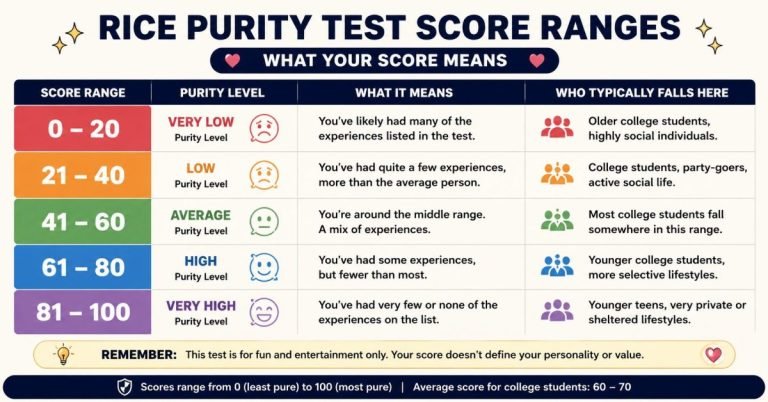
Rice Purity Test Questions List refers to the 100-question checklist used in the Rice Purity Test. The questions cover relationships, partying, social experiences, and risky behavior. Users check off activities they’ve done and receive a score between 0 and 100.
The original version started as a college bonding activity. New students used it during orientation events to break awkwardness and compare experiences without directly asking personal questions.
Today, people repost scores for reactions more than self-reflection. One screenshot turns into a full comment section debate within minutes.
Users who’ve seen the trend on TikTok usually search the question list afterward because they want to know whether the later prompts are actually as wild as people claim.
Why the Questions Feel So Personal
The structure is intentional.
The early questions are harmless:
- holding hands
- crushes
- first dates
- kissing
Then the quiz slowly escalates into more uncomfortable territory involving:
- relationships
- parties
- drinking
- risky behavior
- controversial experiences
That gradual shift creates tension. People keep scrolling because they want to see how extreme the next question becomes.
Most viral quizzes disappear after a few weeks. The Rice Purity Test survives because it mixes curiosity with social pressure.
That combination works online almost every time.
Rice Purity Test Question Categories Explained
Most people don’t actually search for the test itself.
- They search for the categories.
- That’s the important distinction.
Quick Comparison
| Category | Best For | Key Benefit | Limitation |
|---|---|---|---|
| Relationship Questions | Comparing dating experiences | Easy to relate to | Can become repetitive |
| Party Questions | College social culture | Funny score differences | Sometimes exaggerated |
| NSFW Questions | Viral reactions | High engagement online | Not suitable for everyone |
| Friendship Questions | Group participation | Less awkward socially | Less memorable |
| Controversial Questions | Internet debates | Creates discussion | Can feel invasive |
Relationship Questions
Relationship questions make up a large part of the early and middle sections.
Common examples include:
- Have you held hands romantically?
- Have you gone on a date?
- Have you kissed someone?
- Have you been in a relationship?
- Have you said “I love you”?
These questions feel normal enough that almost anyone can answer them casually. That’s deliberate. The test eases people in before the more controversial sections appear later.
Party and Drinking Questions
This section is where college culture becomes obvious.
Questions usually involve:
- alcohol
- parties
- drinking games
- sneaking into places
- staying out all night
Every August the trend spikes again online. Freshmen discover the quiz for the first time, dorm group chats start posting scores, and Reddit threads turn into confession contests within hours.
People rarely remember exact scores later. They remember reactions.
Weird Rice Purity Test Questions
These are the questions that become screenshots and memes.
Usually because they’re:
- strangely specific
- awkwardly worded
- unexpectedly personal
- designed to provoke reactions
The weirdest Rice Purity Test questions spread faster than the quiz itself now because users repost screenshots on TikTok, Instagram Stories, and Discord servers instead of linking the actual website.
That’s how internet trends work now.
Why the Rice Purity Test Went Viral Again
The test existed long before modern social media. Yet Gen Z revived it anyway.
There’s a reason for that.
The quiz fits perfectly into reaction-based platforms where people compare themselves publicly in seconds.
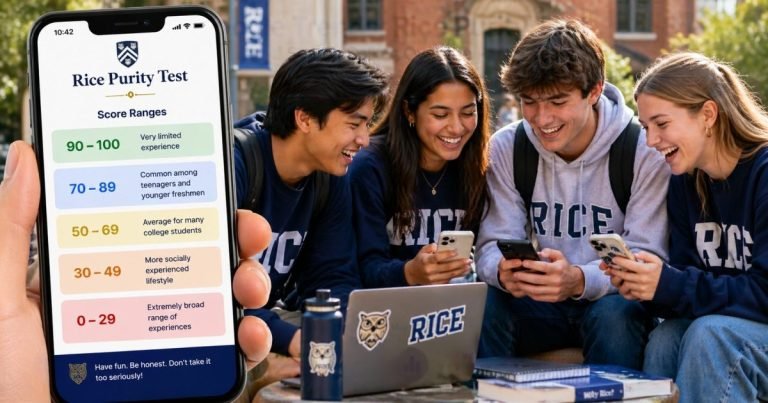
A single number instantly creates assumptions:
- innocent
- chaotic
- sheltered
- experienced
- unpredictable
Even if those assumptions are completely inaccurate.
The “Drop Your Score” Trend
One person posts a score.
Then everybody else joins.
That pattern repeats constantly across:
- TikTok comments
- Reddit threads
- Snapchat stories
- Discord servers
- college group chats
In most cases, nobody even debates the actual wording of the questions. They just wait for the lowest score to appear so the reactions can start.
That’s the entertainment value.
Why Users Search for the Full Question List
A lot of quiz websites make users click through slow pages filled with ads or endless scrolling.
So instead, people search:
- rice purity test full list
- rice purity checklist
- rice purity test questions copy paste
- rice purity test PDF
- full rice purity test questions
Users who’ve tried random quiz pages often just want to skim the categories quickly before deciding whether the quiz is worth taking.
Want to calculate your own Rice Purity score? Try the full Rice Purity Test checklist and see how your answers compare.
Featured Snippet How-To
To view the Rice Purity Test questions quickly, follow these steps:
- Find a full checklist version.
- Review categories before starting.
- Screenshot questions for group sharing.
Simple, Fast. and no endless clicking.
Most Common Rice Purity Test Questions
The full Rice Purity Test contains 100 prompts, but certain questions appear in almost every online discussion.
Common Relationship Questions
- Have you kissed someone?
- Have you dated someone?
- Have you had a crush on a friend?
- Have you been in love?
- Have you cheated in a relationship?
Common Party Questions
- Have you consumed alcohol?
- Have you attended a college party?
- Have you played drinking games?
- Have you been hungover?
- Have you snuck into an event?
Common Social Questions
- Have you lied to parents?
- Have you skipped class?
- Have you stayed out overnight?
- Have you broken school rules?
- Have you pranked someone?
Most people barely remember their exact score a week later. What sticks are the awkward questions that made everyone pause mid-scroll.
That’s why screenshots spread faster than quiz links now.
The Hardest Questions for Most Users
Not academically hard.
Socially hard.
The most controversial prompts usually involve:
- intimacy
- illegal behavior
- substance-related experiences
- deeply personal situations
Some users laugh through the later sections. Others think the test crosses into oversharing culture.
Both reactions make sense.
The reason the trend survives is simple: the quiz creates instant comparison between friends, classmates, or strangers online.
Rice Purity Test Questions by Category
The checklist usually follows a gradual escalation structure.
Early Questions (1–25)
Mostly harmless experiences:
- crushes
- dating
- holding hands
- kissing
- school behavior
These questions are designed to keep participation comfortable at the beginning.
Middle Questions (26–60)
This is where the tone changes noticeably.
Topics often include:
- relationships
- parties
- alcohol
- rule-breaking
- social experimentation
This section creates most of the nervous laughter during group sessions.
Late Questions (61–100)
The final section contains the most controversial prompts.
That’s also where most viral screenshots come from.
Some people think the ending is hilarious. Others find it invasive. Either way, the later questions are the reason the test keeps circulating online years after most internet quizzes disappear.
And honestly, shock value plays a huge role in that.
Rice Purity Test vs Other Viral Quizzes
Not every internet quiz survives multiple generations of social media. This one somehow did.
Featured Snippet Comparison
Rice Purity Test vs Personality Quizzes: The Rice Purity Test works better for social comparison because scores are based on experiences rather than personality traits. Personality quizzes work better for self-analysis. The main difference is entertainment versus identity profiling.
Why This Quiz Stayed Popular
Three reasons explain most of it:
- It’s extremely simple.
- Scores are easy to share.
- The questions escalate dramatically.
That structure creates perfect reaction content for modern platforms. Especially short-form apps.
Frequently Asked Questions
Q: What’s the best Rice Purity Test score?
A: There isn’t one. Both low and high scores get reactions online for different reasons.
Q: How do I see all Rice Purity Test questions?
A: Search for a checklist or full-list version instead of interactive quiz pages.
Q: Should I answer every Rice Purity Test question honestly?
A: Most users do, but many treat the quiz casually for entertainment.
Q: Why does the Rice Purity Test feel invasive?
A: The questions gradually become more personal and controversial as the checklist progresses.
Q: When does the Rice Purity Test trend the most?
A: Usually during college orientation periods or viral TikTok cycles.
Conclusion
The Rice Purity Test never fully disappeared. It just keeps getting rediscovered by new groups of students and social media users.
That’s why the search traffic keeps returning.
Some people take the quiz seriously. Most don’t. But the curiosity around the full Rice Purity Test questions list keeps growing because people want to know exactly what everyone else is reacting to before they start clicking through the test themselves.